


I believe that to do great things, you must do fewer things. That mastery comes from singularity of focus.
But today, we live in a world that’s full of distractions.
With short-form content ruining people’s attention spans, dopamine hits from social media, and shiny object opportunities everywhere.
And so focus has become one of the most valuable assets very few people have.
That’s why, to help you create singularity of focus in your business and life I’ve put together my 3 focus frameworks.
I’ve used these exact same focus frameworks to help me build two billion-dollar businesses and now build a third with my best friends Alex and Leila Hormozi.
Starting with…
Focus Framework 1: Creating tomorrow, today
My dad taught me this habit that changed how I plan my day forever.
Every night after dinner, he’d open a leather journal and do two things:
Write tomorrow’s date
And list everything he’d do the next day
He called it: “Creating tomorrow, today.”
He never missed a night.
In fact, his ritual taught me more about focus than any self-help book.
Now before I end each day, I design the next one. I don’t close my laptop until every last task is crossed off my list.
So how can you apply this?
Map out exactly what you’re going to do before the day begins and write it down somewhere. Every task, no matter how small it may seem.
Otherwise, distractions and other people’s priorities will fill your day for you if you don’t.
But here’s the thing:
Without this next framework, you won’t know what your priorities are that you need to be focusing on…
Focus Framework 2: Zones & Bones
Think of your calendar as an investment plan.
You are the investor, time is your capital. Now in your investment plan, you have 2 things:
Zones: this is where you invest your time.
Think of zones as different ETFs or stocks you would invest your money in.
Bones: this is how many hours each zone gets.
Bones is like deciding how much money goes in each asset. And so now you measure the return each zone gives you back.
Let me give you an example:
Let’s say your Work zone got 60 hours last week.
The return is what those hours actually produced for you. It might have been new deals being closed, funnels being built, or relationships created.
Your Family zone got 15 hours. And your return there is trust, connection, and being present.
Your Personal zone got 10 hours. And it pays you back in energy, health, and overall happiness.
This is exactly how I split my time into 3 different zones: Work, Family, and Personal.
And my rule is that these zones all stay separate.
When I’m in the work zone, I only do work. When I’m in the family zone, I’m with only my family.
And when I’m in the personal zone, I’m only doing personal tasks.
Then I will allocate how many hours (my bones) I will invest in each category (my zones) every week.
So work might get 60 hours a week, family gets 2 to 3 hours a day, and maybe personal gets 2 to 3 hours a day.
And so you start every week with clear focus on where you’re investing your time every day.
Now you might be thinking:
“Okay Sharran, this all sounds great… but how do I keep track of all the tasks I need to do?”
Well, this is where the final focus framework comes in…
Focus Framework 3: The Pull System: Capture, Triage, Execute
Let me tell you a story.
I used to have two to-do lists without realizing it.
Every day I had open loops in my mind that were constantly stealing my focus. It was like having 20 different tabs open on your computer.
And these two to-do lists were:
My actual to-do list
My email inbox
My email inbox had become a to-do list itself.
It had messages sitting from clients and tasks I needed to do, while my actual to-do list was in a separate place.
This meant all my tasks for the day lived in two separate places instead of one. And it was splitting my focus and energy in half.
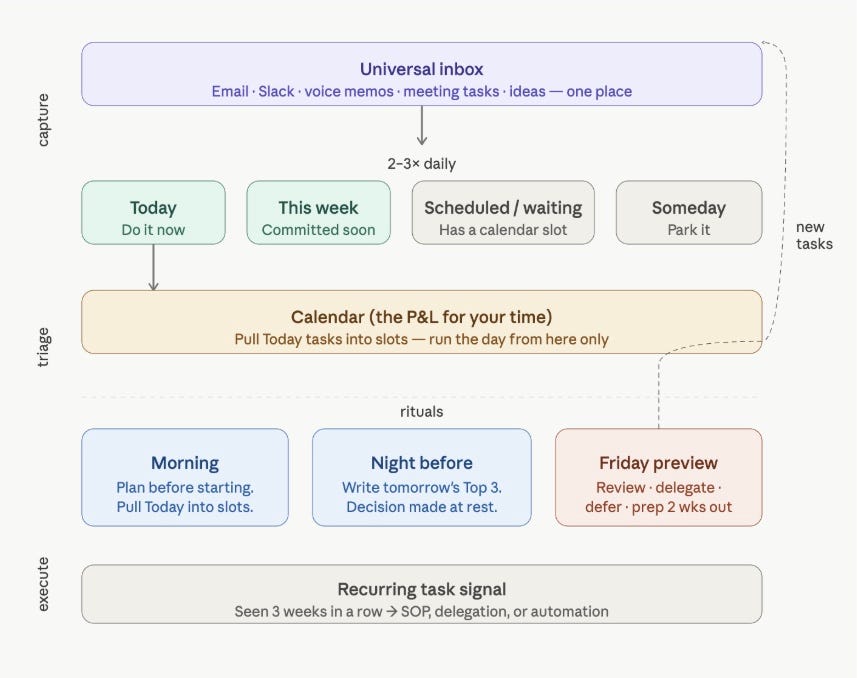
And so this is when I created my 3-stage pull system.
Stage one is to capture everything into ONE inbox.
All your daily tasks get emailed to yourself in one inbox, creating just one to-do list. So they are there as a reminder when other tasks start piling in.
Stage two is triage.
This means you sort each item in your inbox into when you’ll deal with it, and do it a few times a day so the inbox never piles up.
And I sort them into 4 categories:
Today
This Week
Scheduled / Waiting
Someday
I triage my inbox 2-3 times a day. So by the end of the day it should nearly be empty.
And finally, stage three is execute.
Execute means you take the tasks marked Today and invest your time into them on your zones and bones calendar.
And so now you’re back to working from your calendar, not a to-do list.
Here’s what the pull system actually looks like:
So how can you apply these focus frameworks today?
Just pick one of the frameworks from the list and use it tomorrow to protect your focus.
It might be starting with creating tomorrow today to get clear on every task you need to do.
Then 1 or 2 weeks later, you start to run the zones and bones framework to see where your time needs to be invested the most.
But if there’s one thing you take away, make it this:
Singularity of focus is one of the greatest predictors of your success.
Because to do great things, we must do fewer things.
And this is exactly what these 3 focus frameworks help me to do every day.
And if you enjoyed this post, I talk about how to explain anything to anyone in this next one:
How to Speak so Clearly People Think You’re a Genius

When I first came to the US, I had a thick Indian accent and was told I’d never get employed anywhere if I couldn’t learn how to speak.
Thanks man. wish to meet you one Day
Thanks Sharran, These tips will go a long way in helping organize my day..