


Two people can make the exact same amount of money over their lives, but only one of them becomes financially free.
And it’s not because they:
Bought a house with a white picket fence
Maxed out their 401K
Or put their life savings in a savings account
It’s because they understand the real money milestones you need to hit for financial freedom.
And it wasn’t until I understood these 5 money milestones that I became financially free.
But before we talk about financial freedom, we need to understand milestone 1…
Milestone 1: M — Margin
Margin is your active income minus your monthly expenses.
It’s the gap between what you make and what you spend.
Most people’s income and expenses have no gap, which means there’s no money left over to build anything with.
Let me tell you a story.
My college roommate’s dream life was a doorman building in Chicago and a Honda Accord.

To have his dream life, it would cost him $65,000. And so he got the $65,000 job that paid for it.
But then his sister got sick…
She lost her job and her health insurance, and he had to almost double his income just to cover it.
So he went out and got a project management certificate. He did classes for 90 days, paid the fee, and he got a new job for $120,000 a year just a few months later.
Here’s the lesson I took from him:
Create margin on your own terms before life forces you to.
But this next money milestone is how you make sure you can get a higher-paying job without sleepless nights about creating margin.
And I believe this next money milestone may be one of the most underrated milestones today…
Milestone 2: O — Optionality
Looking back over the last 30 years, the day I put this milestone in place is the day everything changed for me.
Because most people think the biggest financial emergency is a flat tire or a dentist bill.
But the biggest emergency is losing your active income entirely.
Milestone 2 is about building real backup for that scenario, which is something most people never get around to doing until it’s too late.
In short, Optionality protects the margin you just built. And the vehicle I use to create this protection is called a transition fund.
A transition fund means you have:
Essential expenses x 6-12 months.
Let me give you an example.
Let’s say your monthly expenses are $4,000.
If you have $24,000 in your transition fund, you have 6 months of runway to find a new job or figure out your situation.
Here’s how to create your transition fund:
Calculate the transition fund target
Separate the money into its own account so it doesn’t get spent
Automate the transfer every payday, so it grows without you thinking about it
If you could put this milestone in place, it would change the very financial bloodline of your family.
But this next milestone is where you go from playing defense with optionality… to playing offense for creating financial freedom.
Milestone 3: N — Net Financial Assets of $100,000
This is where you take the leftover money you have after the transition fund… and start turning it into real wealth.
Let’s say you have assets of $130,000 and your total debt against them is $30,000.
Well, your net financial asset is $100,000.
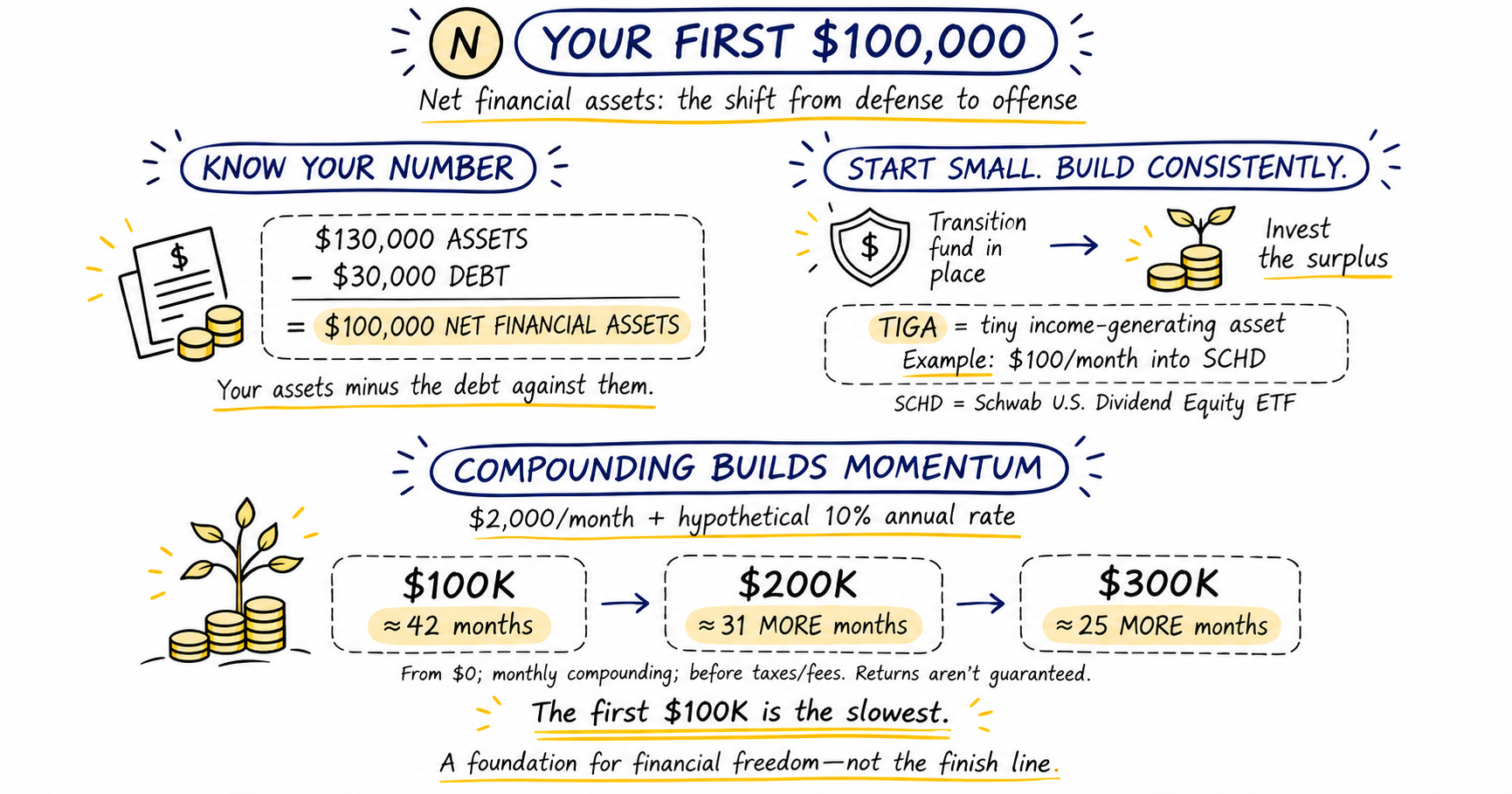
The hardest part about this milestone is actually getting there, because the first $100,000 is the slowest.
Or as legendary investor Charlie Munger would say:
“The first $100,000 is a pain, but you gotta do it.”
Now if you don’t have much money to invest, you can use what I call a TIGA. A TIGA is a tiny income-generating asset.
For example, every month my son invests $100 a month in SCHD, the Schwab dividend ETF.
But if you have more money to spare, let’s do the math for you:
If you invest $2,000 a month and it grows at 10% a year, your first $100,000 takes 42 months or roughly 3.5 years.
The second $100,000 only takes 31 months (2.6 years), and the third $100,000 only takes 25 months (2.1 years).
This is compounding at scale.
But $100,000 in net assets isn’t going to make you financially free.
It’s milestone 4 where you realize how $100,000 can start you down the path to financial freedom…
Milestone 4: E — Equity Rich
Equity rich is $1M in net worth, not including your personal residence.
And in the US, this qualifies you for accredited investor status.
An accredited investor gets access to private deal flow the public never sees. This is what I call the game beyond the game.
Now there are two proven paths for getting equity rich that I call the Golden Stairways…
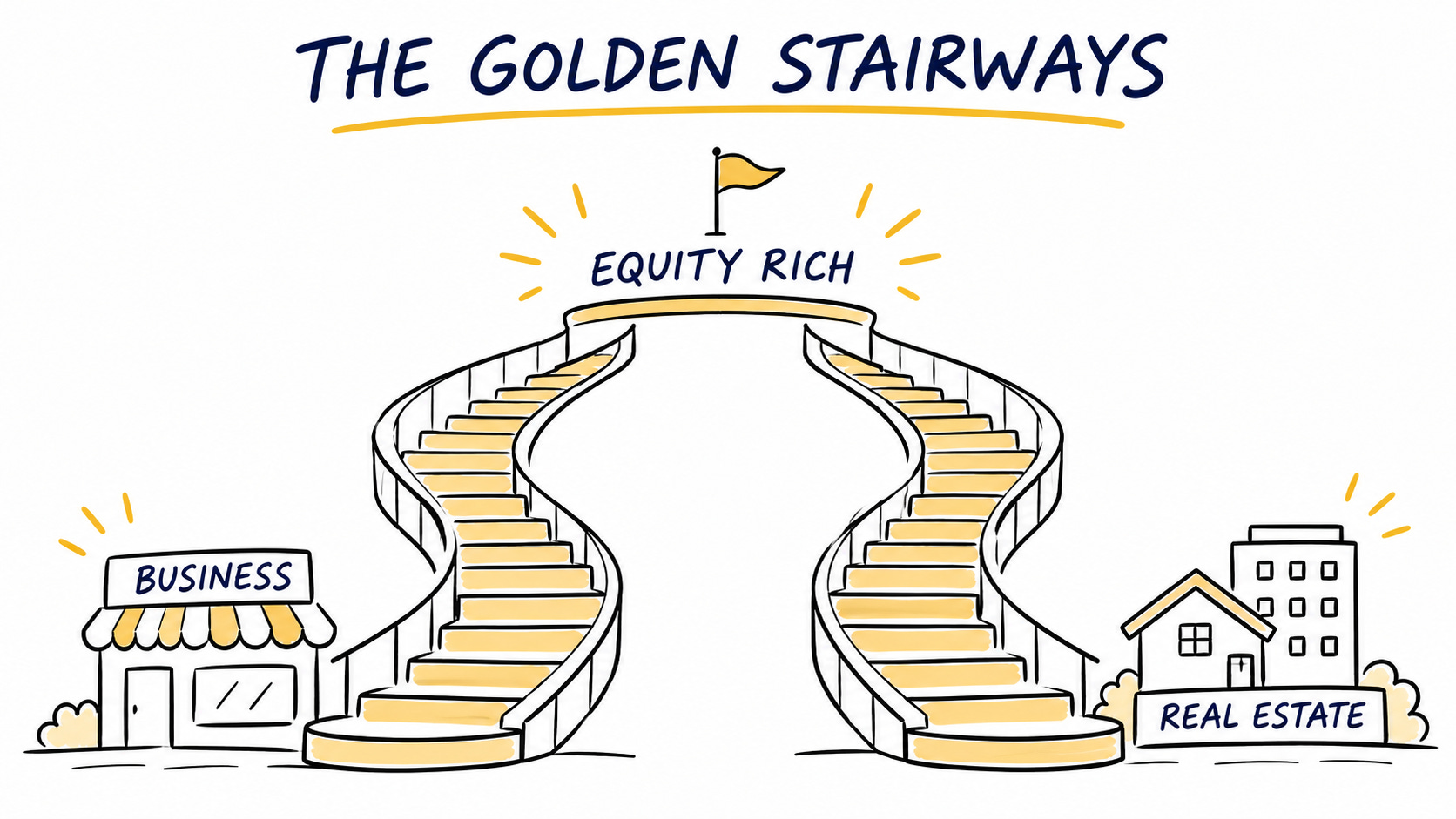
Businesses and real estate.
The Forbes 400 list is dominated by entrepreneurs and owners of companies in business and real estate.
So here are four things that can help you get to equity rich today:
Grow your business’s value: e.g. increasing EBITDA, or the metric that drives your business’s valuation.
Take distributions and reinvest them: this could be pulling profit out of the business instead and reinvesting it in business and real estate to grow your own net worth.
Invest in public markets on a schedule: this could be consistent stock or ETF contributions every month.
Use tax-advantaged accounts and locations: for example, an IRA, 401k, or HSA.
This is the game beyond the game…
But achieving $1M in net worth may not make you financially free…
You can have $1M in net worth and still be working to make that money until the day you die.
Because it’s milestone 5 where financial freedom becomes a reality.
Milestone 5: Y — Living Life On Your Terms
Financial freedom is when your passive income is greater than your monthly expenses.
Passive Income > Monthly Expenses
Passive income is pre-funded income. It’s when you stop trading time for money.
And you can create passive income in two ways:
Pre-fund with money
Pre-fund with effort
Let me give you an example.
If you prefund with money, it could be investing $100,000 into a dividend ETF yielding 4%. That dividend makes you $4,000 a year, and you’re not working to make it.
If you prefund with effort, you could spend 6 months building an online masterclass. And then the online masterclass keeps selling without any more work from you.
Once your passive income is greater than your monthly expenses, you have reached financial freedom.
It’s when you can wake up in the morning and ask: “What do I want to do today?”
Work now becomes a choice.
But here’s the thing:
Most people have no idea which money milestone they are actually at. And to reach financial freedom, you need a money plan.
Because every money goal needs a money plan.
That’s why I’ve put together 21 years of my wealth knowledge and created a free Wealth Roadmap for you.
I wrote down all the lessons I learned from:
Goldman Sachs
Investing in 131 companies
Building 2 billion-dollar businesses
And I reverse-engineered everything into the Wealth Roadmap framework that you could use to become wealthy.
It tells you exactly what money milestone you are at and how to get to the next stage toward financial freedom.
Your main man,
Sharran
P.S. Thank you to everyone who responded in the chat about what content you want to see, I read every comment.
Thank you for this. I bookmarked it and will return to it often as a reminder. You think you know this stuff, but knowing is doing so i have a long way to go
I enjoyed reading that. An article that broadly touches a lot of different steps, lightly, on a financial ladder