


All the finance gurus give the same advice:
Just buy the S&P 500.
Set it and forget it.
It’s the safest bet in investing.
But I think that advice is dumb.
Because almost nobody who takes this advice understands what they’re buying with the S&P 500.
So today I’m going to show you what the S&P 500 actually is, why it’s not as safe an investment as most people think, and the one stock I’m using to retire instead.
In fact, this is the same stock I’m putting my own kids’ money into.
But before we talk about what that stock is, you need to understand something that nearly everyone gets wrong about the S&P 500…
You don’t own 500 equally weighted stocks… You own 7.
Most people think buying the S&P 500 spreads their money across 500 companies.
And this is because it’s what most of the finance gurus tell them.
But here’s the thing:
The S&P 500 doesn’t spread your money equally.
An S&P 500 index fund is cap-weighted.
Cap-weighted means it owns most of whatever is already the biggest by market value, not whatever is best.
Today the top 10 holdings make up 37% of the entire fund.
This means the top 3 alone, Nvidia, Apple, and Microsoft, are 21% of the S&P 500.
And the Magnificent 7 are around 34%:
Apple
Microsoft
Alphabet (Google)
Amazon
Nvidia
Meta
Tesla
And so every $10,000 you put into an S&P 500 fund sends about $3,400 straight into just 7 companies, not 500.
This is why the S&P 500 isn’t as diversified as most people believe…
It’s still a bet on 7 stocks.
Now when someone tells you to:
“Just buy the S&P 500 bro.”
You can translate it to:
“I’m investing over a third of my money into 7 stocks, which are at some of the highest valuations on record.
And they’re weighted toward whatever has already gone up the most.”
Now investing like this can still work. But only if you understand this next part because…
This has all happened before.
Every generation has its own group of safe stock giants. And every time, the index fund shares the same fate as them.
Let me give you an example.
In the early 1970s, it was the Nifty Fifty:
Xerox
Polaroid
IBM
Coca-Cola
Avon
Investors were paying high prices because they expected those companies to keep growing.
But then the market crashed…
And owning an index fund didn’t protect investors from the fallout.
The dot-com crash in 2000 did the same thing…
The S&P 500 took about 7 years to return to its previous high between 2000 and 2007.
That’s 7 years to get back to where it was, and over a decade once you adjust for inflation.
Read that again.
This is the risk nobody understands.
And this is why spreading your money across hundreds of companies in an index fund doesn’t mean you can’t lose money or spend years waiting for a recovery.
But there is one stock I believe is safer than the S&P 500 and index funds…
This stock has beaten the market over 60 years.
It’s Berkshire Hathaway stock.
Berkshire Hathaway is the investing giant built by Warren Buffett and Charlie Munger.
Here’s why I would choose Berkshire Hathaway over the S&P 500:
If you put $100 into the S&P 500 in 1964, you’d have around $46,000 by the end of 2025.
But if you put that same $100 into Berkshire Hathaway stock, you’d have $6.1 million.
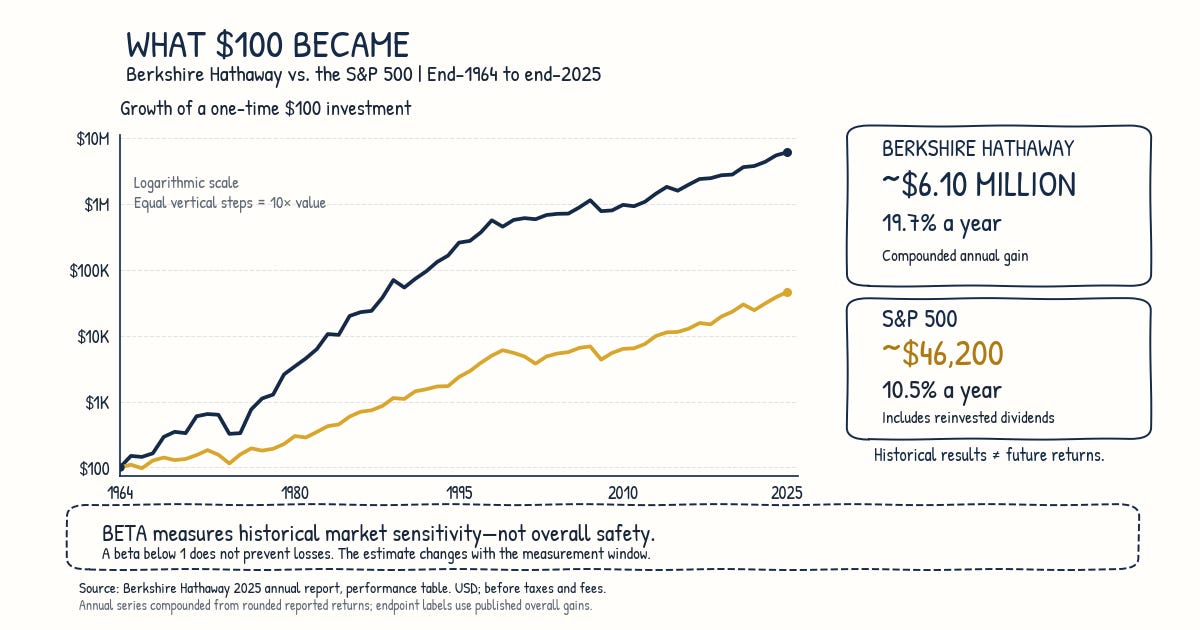
No, that’s not a typo… it’s a return of over 6.1 million percent.
The S&P compounded at about 10.5% a year. Berkshire did 19.7%.
But it gets even better…
Berkshire’s beta is around 0.65. And beta measures how sensitive a stock is to movements in the overall market.
So if the market’s beta is 1…
Above 1 = The stock may react more to market swings.
Below 1 = It may have less of a reaction.
So Berkshire’s beta of 0.65 means it has historically moved less than the market.
In short, it means higher returns and lower reaction to market swings.
Now you may be wondering how one company could be potentially safer than the S&P 500.
And the answer is that…
Berkshire isn’t just any ordinary stock.
When you buy an S&P 500 fund, your money follows the index.
And the fund is weighted toward companies with the highest market value.
But when you buy Berkshire, it owns businesses across multiple industries:
Insurance
Railroads
Energy
Manufacturing
And much more.
Its management decides where to reinvest the money those businesses earn.
And so, in my opinion, Berkshire has 3 advantages that the S&P 500 doesn’t:
1. Its insurance businesses generate money to invest.
Customers pay their insurance premiums before Berkshire needs to pay their claims.
Meaning they have liquid cash they can use to invest in the meantime. This is called an “insurance float.”
When premiums cover claims and expenses, Berkshire gets access to that money without paying interest.
But it still has to pay the claims when they are made.
2. Management can choose where the money goes.
It can buy stocks, buy entire businesses, invest in businesses Berkshire already owns, or just wait and hold.
This flexibility in where they invest is the entire approach that Warren Buffett and Charlie Munger built at Berkshire.
3. It keeps cash available for opportunities.
Berkshire follows Buffett’s own investing principle of having dry powder.
Dry powder is money you can invest the moment an opportunity shows up.
And so when the market has a downturn, they are ready to buy investments at better prices.
This is because they also follow another of Buffett’s principles:
“Be greedy when others are fearful and fearful when others are greedy.”
So Berkshire’s stock can fall during a crash too.
But they can use their available cash to make investments that may pay off in a decade’s time because they are playing the long game.
On the other hand, an S&P 500 index fund is still invested as the market crashes.
They don’t set cash aside specifically to make investments in a down market.
So now let me tell you about how I’m setting this up for my kids because…
I don’t want my kids spending their lives staring at stock charts.
I don’t want them chasing hot stocks or panic-selling in the next crash.
This is why I’m building their portfolio around one stock they don’t have to think about:
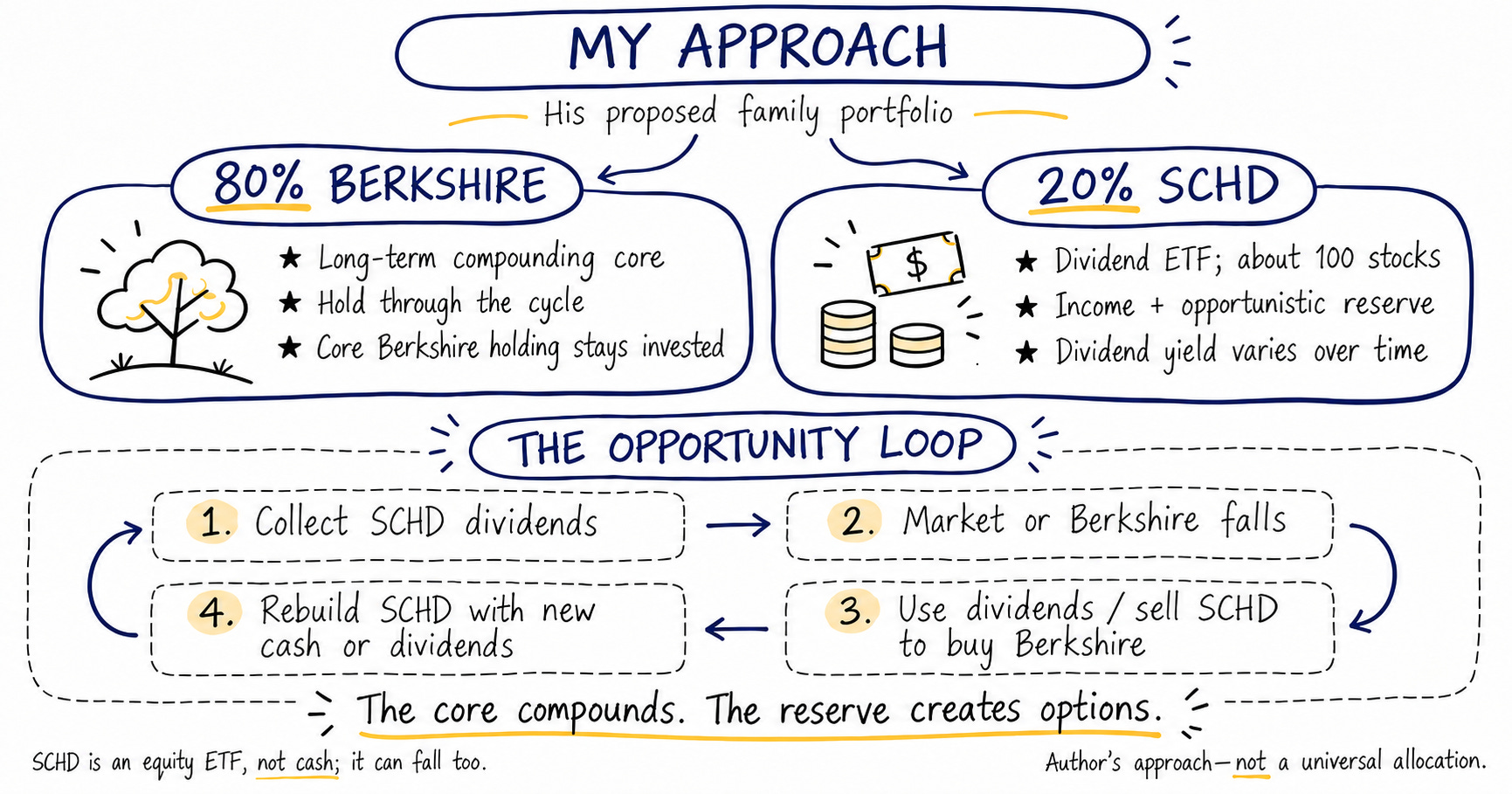
80% in Berkshire.
I buy once and never sell.
But I don’t just put 100% in one Berkshire stock…
I want something to pay me quicker while I leave Berkshire compounding, so…
This is the portfolio I’d recommend to 100% of my family.
80% goes into Berkshire as the long-term play.
20% goes into SCHD.
SCHD is an ETF fund (not a stock) of about 100 dividend-paying stocks that pays me around 3.3% a year to hold it.
This is how I create my opportunistic cash.
And so when the market or Berkshire drops, I move the SCHD into more Berkshire at the lower price.
The dividends from SCHD become dry powder to buy Berkshire on sale.
Once things recover, I build the 20% SCHD back up with new cash or distributions from the dividends.
But I never sell the 80% Berkshire.
In short, the 80% Berkshire compounds and the 20% SCHD pays me to be patient.
Because time in the market beats timing the market.
Which means the crashes everyone else fears become my buying opportunities.
Now let me be honest: anyone who sells you a one-stock retirement with no downside is lying.
Berkshire doesn’t win every year. In 2025, it returned about 11% while the S&P 500 index did about 18%.
SCHD also fell about 33% in the 2020 crash.
And Buffett is in his nineties. As of 2026, Berkshire has a new CEO, Greg Abel.
This is the first real test of whether it works without Buffett.
I personally think it does, because the system he has built was designed to outlive him.
But I won’t pretend there’s no risk…
So this is the plan:
One stock to retire on
One stock for my kids
A second option that pays me to wait
If you enjoyed this post, I break down how you can learn the skill of avoiding burnout in this next one:

P.S. I have taken 21 years of wealth knowledge and turned it into a personalized wealth roadmap that gives you actionable steps and tactics you can use to make yourself wealthy:
>> Click here for your free wealth roadmap
makes a lot of sense, while it's true it's hard to beat the s&p and hence where the whole advice comes from, it's even harder to beat Berkshire 😂 in the short term sure you can smoke both of their returns if you get in on momentum like with ai or gold a couple years back but then it's not a set it or forget it kind of strategy - really just depends what you're going for and if you're going for minimal effort then what you described sounds pretty fire