


Three years ago, we almost walked away from a $12 million investment.
Here is what happened:
The founder had just fired his COO.
The company was doing $40 million in revenue. Everything looked solid on paper.
But during diligence, I asked to meet with the team to understand who actually ran the business.
The founder pointed to himself.
I asked who documented the processes. Who wrote down how things worked. Who could train someone new if a key person left.
The room went silent.
We passed on the deal.
Six months later, the company imploded.
The head of sales quit and took the entire playbook in his head with him. Revenue dropped 60% in 90 days because nobody else knew how the sales process actually worked.
That near-miss taught me something: the most valuable person (MVP) in any company may not be who you think it is.
The Wrong Answers
Most people think the most valuable person is:
The operations manager who does everything
The EA who knows where all the bodies are buried
The controller who has access to all the bank accounts
The founder who’s been there from the start
Of course, these people are valuable.
But who is the MVP?
Here’s what I learned after building $2 billion companies, working at Goldman Sachs and Credit Suisse, investing in over 100 deals, and watching over a dozen companies almost die from a single departure:
The MVP is the one with insane depth of understanding of how every single thing works.
If you lost them, you’d lose so much institutional knowledge that you’d spend 6 months just figuring out what they knew. But if you lost someone else, this person has enough documented information to train anyone else in 2 weeks.
So, who is it?
The Hierarchy of Value
Now when we invest in a company or consult with a CEO, we rank people this way:
The person who wrote everything down
The person who did what was written down
The person who read what was written down
The person who talked about it
Let me break this down.
Number 1: The person who wrote everything down has the most operating, logistical, and contextual knowledge of the business. They are arguably the most valuable person in the company.
Why?
Because they stopped to think about what was actually important. They organized their thoughts. They documented it in a memo, a strategy document, or an SOP.
The act of writing forced them to understand all the interconnectedness and the pieces of the company. They can see patterns no one else can see.
The person who writes the memo or the SOP knows everything about the thing.
Number 2: The person who did what was written down is second most valuable. They executed the steps. They know how it works in practice. But they didn’t have to think through why or how the pieces connect.
Number 3: The person who read what was written down is third. They have cursory understanding and generally know how the thing works. If pushed, they could point to some key elements or ask some thoughtful questions. Heck, they also may not even know anything as they may have been ultra-distracted when they read the memo.
Number 4: The person who just talked about it understands it conceptually. Very often this is the manager or founder. They know how it should work in theory. But from an organizational operational perspective, they don’t run the business especially if the business has gotten bigger. They don’t know the intricacies of how things actually work.
I’ve seen this play out time and time again.
The person who just talks about strategy gets caught flat-footed when someone quits. However, our hometown MVP, the person who wrote down how everything works can train a replacement in days, not months.
Change Your Approach
I have noticed that most people reserve “writing” for extremely important decisions. I would offer to rethink that frame and make writing the default mode for every decision.
Let me give you an example of what I was working on recently that in most companies would have been an unstructured zoom call or a confusing slack thread.
I have been thinking about launching an internal mastermind at Acquisition.com.
I’ve been thinking about it for months
I talked to a few people about it
But nothing ever came of it (because I did nothing)
So, last week I sat down and wrote the memo to our team launching the idea of the ACQ Roundtable.
Here is a peek at the top part of the memo that I wrote.
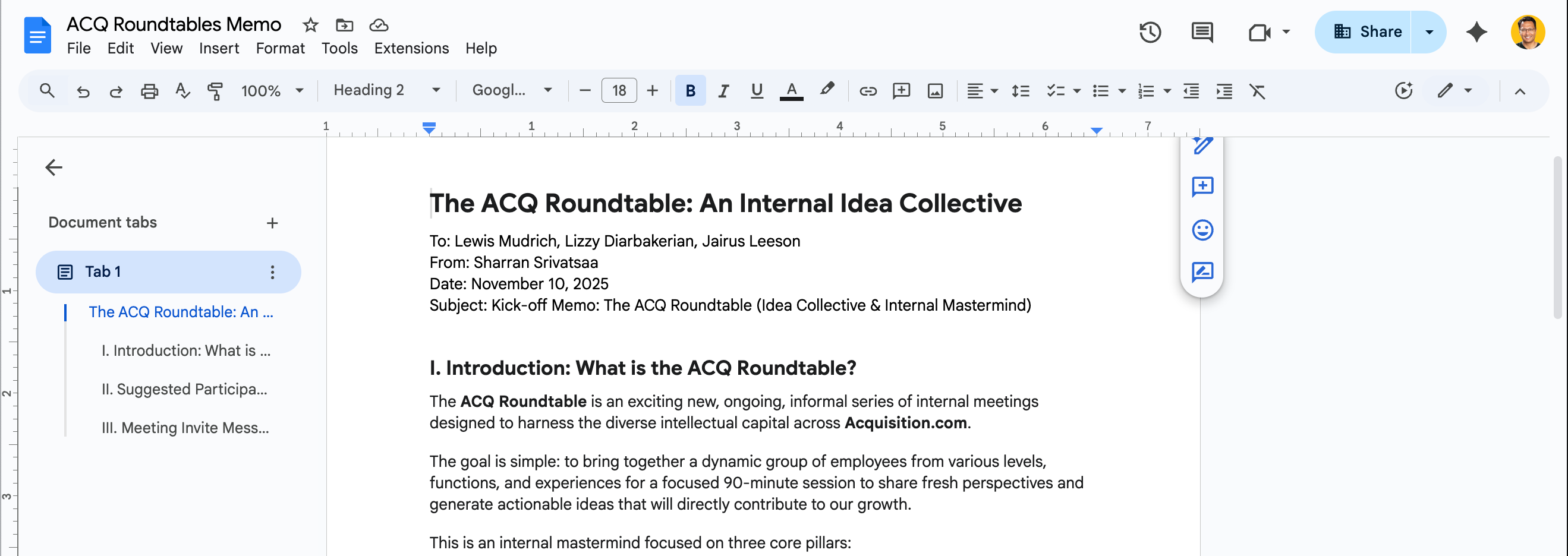
While I can’t give you access to the document as it has a lot of proprietary ideas and information, here were the sections inside the memo:
What is the ACQ Roundtable
Key Features
Participant Methodology
Invite Messaging (along with a video I recorded)
Meeting Agendas
Media Team Collaboration (to capture it)
Support Team (to help organize it)
Kickoff Plan
With this one simple document, I have now laid the foundation for something special at the company that will not only work smoothly, generate value for the business, build culture, and most importantly, will be easier to transition ownership as and when I am ready.
The Ownership Guarantee
Here is the lesson I want to share with you.
Your ability to write things down will guarantee you more success than any MBA, any networking, or any fancy title.
I’ve watched this play out across 100+ investments. The person who documents becomes indispensable, while the person who just executes often becomes replaceable.
Because when you write it down, you’re forced to understand why it works that way. What breaks if you skip a step. Where the decision points happen. That depth of understanding is what makes you valuable.
The person who writes it down owns it.
If you liked this post, you would like this one too!

Cost controller or possibly the document controller if your in engineering construction. I work in document control and nobody cares about what we do until they need to recall the information legally
Can you lay out the process for “writing it down”?
For processes, checklist, SOP’s, and memos.
I’m doing this for the first time and struggling with organization.