


Two families can make the exact same amount of money over their lifetimes.
Yet only one of those families actually creates generational wealth.
Why?
The difference is never how much they made… It was the system they used to keep it and pass it down.
So today I want to show you one of the most powerful systems I know for creating generational wealth that you can use for your own family.
I call it the Family Wealth Tree, and it has four branches.
Starting with…
Branch 1: Rules
The rules are written agreements that define what family members can and cannot do with shared assets.
This could be writing a family constitution before there’s anything to fight over.
So you write it while everyone is still calm because you may not be able to write it later.
Now you might be wondering, “But Sharran, what if I want to take money out of the shared assets?”
You write a family memo.
This is a written proposal to all the family members that explains 5 things:
Amount: How much money is requested?
Purpose: Why is the money needed?
Action: Which account will be used, and what happens next?
Risk and timeline: What could happen, and how long will the funds be invested?
Approval: Who must approve the request?
Let me give you an example:
Amount: I want to take out $10,000 from the family fund
Purpose: I’m going to invest it in 4 ETFs to protect the money from inflation and help it grow
Action: I’m going to withdraw from X account
Risk and timeline: The funds will be invested for 5 years with a target of 10% growth annually. But returns are not guaranteed, and the investment may lose value
Approval: I need Mom and Dad’s approval before making the withdrawal
If they can’t answer those 5 questions, they don’t get to take money out.
Because if they can’t explain how they want to use the money in a few sentences, they don’t have a money plan for it.
No family memo, no withdrawal.
But there may be no wealth to withdraw from without this second branch in the Family Wealth Tree…
This is what keeps the wealth together and allows it to be passed on from generation to generation without losing value…
Branch 2: Structure
Structure is how your wealth is held and transferred without losing it.
This is the legal structure, which is the part that protects and transfers wealth without losing a chunk of it to taxes at every single generation transfer.
Let me tell you a story about how important structure is:
Cornelius Vanderbilt died in 1877 with a fortune worth somewhere between $95 and $105 million (about $3.34 billion today).
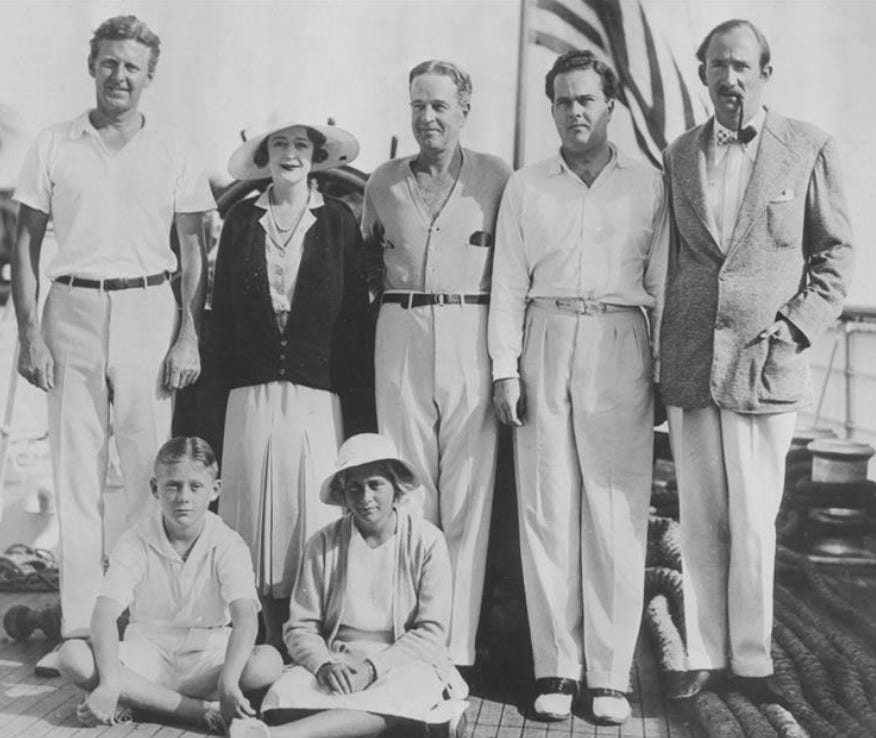
This was bigger than the entire US Treasury at the time.
And he left roughly 95% of this fortune to his son with explicit instructions to not waste it.
But Cornelius Vanderbilt had made one crucial mistake…
He had not created a structure to protect any of his wealth.
So the Vanderbilt heirs split the money, built mansions, and lived off dividends while the underlying railroad business the family fortune was built on collapsed underneath them.
And so in 1973, 120 Vanderbilt heirs gathered at a family reunion… how many of them do you think were still millionaires?
50?
25?
Not one of them was a millionaire.
Because with every handoff of wealth to the next generation, two things happened:
Estate tax
Transfer tax
Then whatever’s left gets split between multiple heirs who were wasting it.
In short, with every transfer to the next generation, the Vanderbilt fortune was being destroyed by both taxes and bad investments.
But if they had built a structure, the Vanderbilts may still have a fortune today.
For example, a dynasty trust could have broken this cycle.
A dynasty trust means the family fortune goes into the trust once, pays transfer tax once, and then never leaves.
So the assets aren’t re-owned and re-taxed every generation and the heirs get income they can borrow against.
And the most important part is that the wealth stays inside the trust and keeps compounding untouched.
But those assets may not be able to be borrowed against or compound without this third branch of the Family Wealth Tree…
This decides if cash actually reaches each family member…
Branch 3: Liquidity
Liquidity is simply how the cash reaches family members without disturbing the core assets.
Now the goal here is to build access to cash so you never have to sell a long-term asset to solve a short-term problem.
And this is something the Rockefeller family solved decades ago…
To make sure their family bank always had liquid cash, they used the infinite banking concept.
The infinite banking concept is when the family trust buys a life insurance policy for every family member.
And as their policies mature, two things happen:
They pay dividends back into the family bank
They build cash value inside it
This creates liquid money inside the family bank.
So now family members can borrow from the bank for investments, a business, real estate, whatever they need.
Once they pay it back, it goes back into the pot for the next family member who needs it.
And when someone in the family passes away… the policy pays out, which adds even more liquidity to the bank.
And so the liquidity in the family bank just keeps growing.
Every new baby gets a new policy and every death adds a payout.
Which means you’ll never have to worry about being asset-rich but cash-poor as a family.
But your bloodline could still end up being both asset-poor and cash-poor without the most important branch in the Family Wealth Tree…
This is the branch that decides whether the money actually survives and grows with every generation…
And it has nothing to do with the money itself…
Branch 4: People
This is the human part of the wealth tree.
Because here’s the thing:
The rules, structure, and liquidity will only be as effective as the people who are using them.
This is why the knowledge and training you give the next generation is the most valuable asset in this entire generational wealth system.
And this is exactly what I’m doing with my own kids.
When my daughter was seven, I partnered with another dad and we bought a small e-commerce site together.
The site was called 100unicorns.com, but this was not some fake store.
This was a real business with real orders and real people on the other end expecting a product that they paid for.
She could log into the back end of the website and see every single transaction. She was the CEO and she had clear responsibilities.
Now the business never made any meaningful money, but that was never the point.
You see, when kids just get handed money, they almost never connect it to the value that they created.
They have a distorted perspective of how money works: “I just get handed money”.
But when your kids solve a problem for someone, like when they fulfill an order for a unicorn blanket, they start to understand that there was a trade.
Someone paid money in exchange for something they did and that something was not an allowance that they got every week.
And so this is what 100Unicorns did for my daughter.
It was changing her beliefs around money and value creation.

This is why you need to teach the next generation before you hand them the keys.
This is the Family Wealth Tree…
This is what the Vanderbilts never created that may have protected their fortune.
I talk more about how I’m raising my kids to be millionaires with the Millionaire Kids Flywheel in this next post:

This is the knowledge we need to pass down to our kids that schools won’t teach them…
Sharran - I’m a KW agent, my feed is full of smart real estate people, and you consistently bring the most value. Thank you for all the insights and recommendations you put out there. I’ve learned a lot from you. 🙏
You explain this so well. The best rules, structures and financial strategies in the world are only as effective as the people who understand them, make good decisions with them, and actually follow through. That’s why I think financial education is such an overlooked part of wealth creation and legacy. You can build the most sophisticated structure imaginable, but if the next generation doesn’t have the knowledge, mindset and capability to use it, the structure becomes almost irrelevant. Build the system. But build the people who can operate it. That’s where the real legacy is created.