


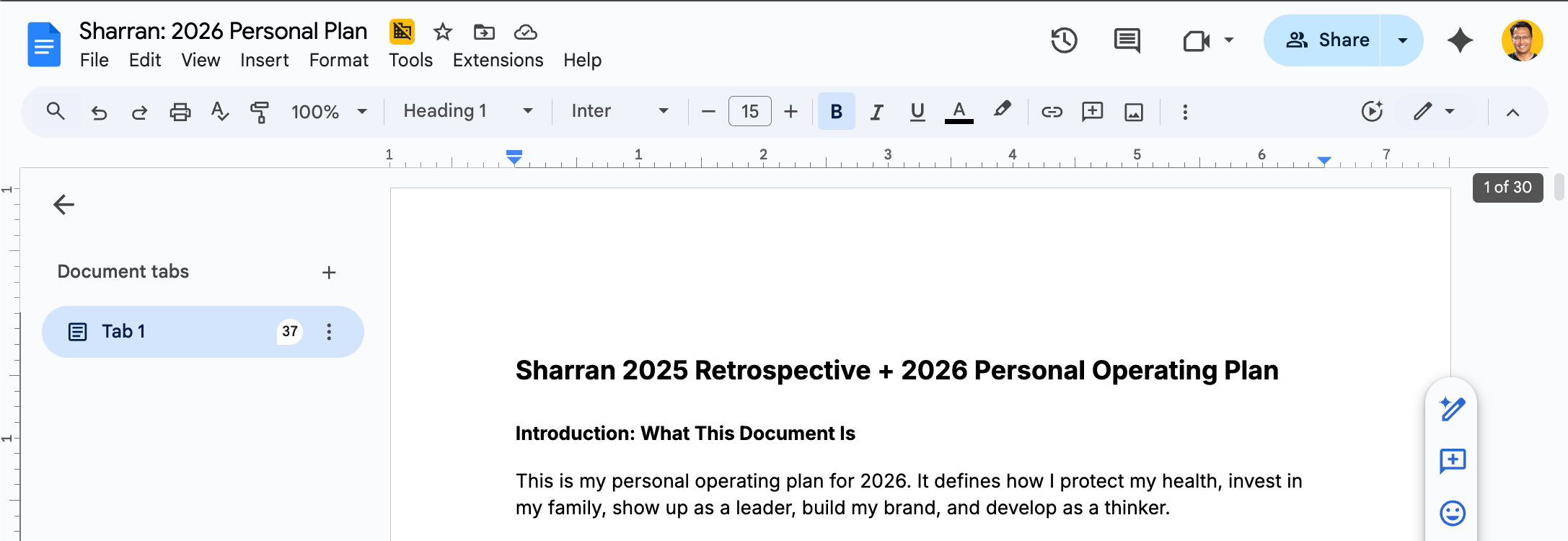
I spent the last seven days of 2025 writing a plan for 2026.
The final document is 42 pages long.
It covers my health routines, my work priorities, my crazy ambitions and most importantly how I can be a better father and husband.
The plan has three parts.
Part one is a retrospective of 2025.
Part two defines what success looks like in 2026.
Part three lays out the systems and rules that will keep me on track.
The reason I am writing this post is to explain how important the retrospective part of the process is and how it really does inform and frame everything that you are thinking about doing in the future.
Most people skip this step. (I used to be most people)
They jump straight into setting new goals without understanding why last year’s goals failed. I did not want to repeat the same mistakes. So I spent two full days doing a legit retrospective before I wrote a single word about 2026.
Let me show you the exact process that I used.
What I Did
First, I went back through my calendar week by week. I looked at who I met, what I did, and where I was. I let it jog my memory. Some weeks were packed with meetings and travel. Other weeks were quieter but jamming in a different way.
Then I opened my photos app and scrolled through the entire year. I saw trips I had completely forgotten about. I saw moments with my kids that put a smile on my face. I also saw times when I looked tired or stressed taking a red-eye. No bueno.
Next, I went back through my sent emails from the entire year. I read messages I wrote to my team, my partners, and my family. I could see patterns in how I communicated. I could see where I was clear and where I was just vague. I could clearly see where I was kind and where I was too direct or too short. This had to change.
Then I went through my task list and looked at every project I completed in 2025. Honestly, I had forgotten about most of them. Things that stressed me out in March did not even matter by December. That’s when I realized something. Most of what feels urgent right now will probably not matter in three months.
That definitely changes how I think about what needs my attention today.
After going through all of this material, I sat down and organized what I learned into three categories: wins, gaps, and mistakes.
Wins: I wrote down 8 things that went well in 2025. These were outcomes I was proud of or decisions that paid off.
Gaps: I wrote down 6 things I did not do well. These were areas where I fell short or did not follow through.
Mistakes: I wrote down 4 specific decisions I would change if I could go back and do the year again.
Finally, I wrote down what I would coach myself to do differently.
If I could go back to January 1, 2025 and give myself advice, what would I say? I wrote 8 specific pieces of coaching based on what I had learned.
What I Learned
I learned that I moved at the speed of the business instead of the speed of my plan. It was an awesome year and things moved fast in 2025. I played the game and adapted constantly. But my written plan was not detailed enough to keep up. I worked my face off and always felt like I was behind the 8-ball. I needed something more precise so I could stay ahead instead of always catching up.
This is when it clicked for me that precise planning reveals what infrastructure you need to build.
When I did not plan in detail, I did not know what systems to build ahead of time. So when I took on new projects, I had to figure it out as I went. It took more effort than it needed to. In 2026, I planned first so I could see what infrastructure I needed. Now I can build the systems before I start the work instead of building them while I am doing the work.
I also learned that I did not protect my buffer capacity (aka thinking and strategy time)
I committed all my time to planned work. When something urgent came up, I worked nights and weekends to handle it. I got the work done, but it left no room to think strategically about what comes next. I often explained to my partners how I was very “down and in” instead of “up and out”.
I learned that I need to spend more time on knowledge transfer, not just task delegation. When people understand the reasoning behind decisions, they can help solve problems instead of just executing instructions.
The more I can transfer knowledge about how I evaluate tradeoffs and make decisions, the more leverage I can create. I had not invested enough time in that in 2025.
These four insights came from spending two days looking back. You can do the same thing in less time.
How You Can Do This
You do not need two full days.
But you may need more than 30 minutes. Here is the process:
Go through your calendar week by week for the entire year. Look at who you met, what you worked on, and where you spent time.
Scroll through your photos from the entire year. Look for trips, events, and moments you forgot about.
Read through your sent emails or messages from the year. Look for patterns in how you communicate. Do you want to be the recipient of your own emails?
Review your completed projects and tasks. Notice what you accomplished and what you forgot. Pay attention to things that felt urgent in the moment but did not matter months later.
Organize what you learned into three buckets: wins (what went well), gaps (what you did not do well), and mistakes (what you would change if you could go back).
Count how many items you have in each bucket. I had 8 wins, 6 gaps, and 4 mistakes. Your numbers will be different.
Ask yourself: what caused me stress? What did I not handle well? Write down the patterns you see. It will be quick.
Write down what you would coach yourself to do differently if you could go back to the start of last year. Be specific.
This process will give you 10 to 15 big learnings. Those learnings become the foundation for your next plan. You will know where you failed, what systems you need to build, and what habits you need to change.
In essence, your plan will protect yourself from yourself.
Otherwise there is a high likelihood of you repeating the same dumb sh*t… without your knowledge. While this is not your fault, it is your problem.
Pro Tip: If you want help organizing this, copy this entire post into an AI tool like ChatGPT or Claude. Ask it to build you an interview script based on these steps. Then have it ask you the questions one at a time and capture your answers. At the end, ask it to organize your responses into wins, gaps, and mistakes. It will give you a structured retrospective in 10 mins instead of two days.
A Bonus If You Create Content
If you create content, this process will unlock stories you forgot you had.
I went back through my calendar and remembered helpful conversations with mentors and business partners. I looked at my photos and saw moments that taught me something important. I read my old emails and found decisions I made that turned out well or turned out poorly.
All of those moments are content.
The stories you lived but never captured. The lessons you learned but never wrote down. The mistakes you made that could help someone else avoid the same problem.
Meaning, if you had a full-time videographer on you, they would’ve captured all of it. Now you get to do that!
I pulled out dozens of ideas while doing my retrospective. Some will become blog posts. Some will become podcasts. Some will become case studies that I share with my team. Just to be clear, I was not looking for content when I started. I was looking for sneaky patterns that I could learn from. But the patterns turned into stories, and the stories turned into material I can teach from.
If you do not go back and capture what happened, you will forget it. If you forget it, then you will make the same mistakes again. Which is no fun… for anyone.
I remember this quote that was on our fridge when I was growing up:
“Do not make the same mistakes twice. Find new ones”
If you liked this post, then you will like this one too:

Thanks for share with us this. I already schedule the plan to make a review on the past.
Could you please share with us the part 2 and part 3?
Watch out for ZedAxis TOKEN..!!